The Science of Effective Public Speaking
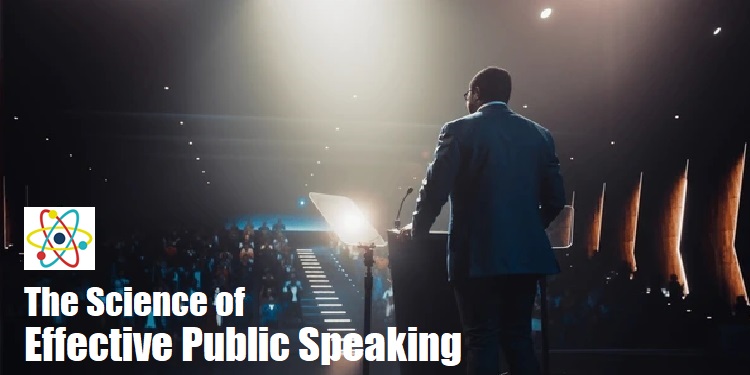
Public speaking is a learnable skill that combines psychological insights with physical control to deliver a powerful message. By understanding how the brain processes information and how your body reacts to stress, you can move past the fear of the spotlight and focus on truly connecting with your audience.
The Impact of Communication
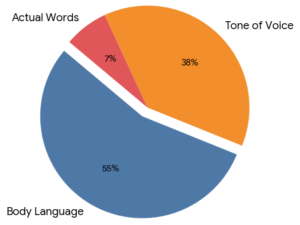
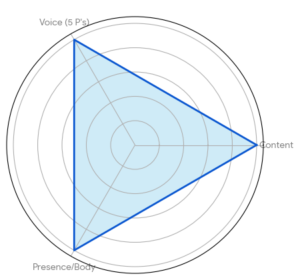
Many people focus solely on their script, but research by Albert Mehrabian suggests that the “how” is often more important than the “what.” In high-stakes emotional communication, listeners derive meaning from three distinct sources.
Overcoming “The Spike”: Anxiety Over Time
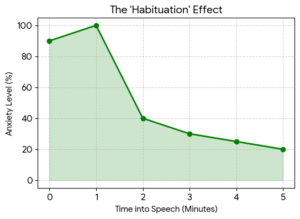
Nervousness is highest just before you walk on stage and during the first minute. Understanding the Habituation Effect helps you realize that if you can get through the first 60 seconds, your biological stress levels will naturally drop.
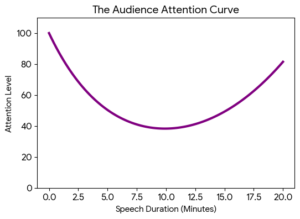
Fighting the “Attention Sag”
Audience attention is not constant; it follows a U-shaped curve. They remember the beginning (Primacy Effect) and the end (Recency Effect) the best. This is why your Hook and Closing must be your strongest elements.
The Rule of Three
To make your content memorable, group your main body into exactly three points. The human brain is optimized to recognize patterns of three, making it the “sweet spot” for information retention.

The Delivery Triangle (A Balanced Approach)
Power Posing (The Mind-Body Connection)
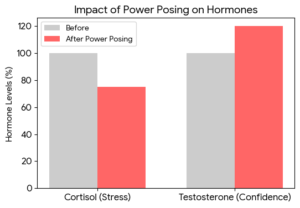
Before you step onto the stage, find a private space (like a restroom or dressing room) and stand in a “high-power” pose for two minutes. This involves standing tall with your hands on your hips and feet apart. Research suggests this can lower cortisol (stress hormone) and increase testosterone (confidence hormone), making you feel more assertive and less reactive to stress.
Box Breathing (Physiological Regulation)
When you feel your heart racing, your nervous system is in “fight or flight” mode. You can manually override this using Box Breathing. This technique-used by Navy SEALs and athletes-regulates your heart rate and redirects oxygen to your brain, allowing you to think more clearly during your introduction.

Becoming a great speaker isn’t about being perfect-it’s about connecting with your listeners. By using simple structures, staying calm with breathing techniques, and practicing your delivery, you can turn your nerves into positive energy. Public speaking is a skill that gets better every time you try, and with these tools, you are ready to speak with confidence and share your message clearly.