History of English Drama
Drama is a distinctive genre of literature and performance that brings stories to life through action and dialogue. Originating from the Greek word ‘dran’, which literally means ‘to do’ or ‘to act’. Drama is unique because it is primarily written to be performed by actors on a stage before a live audience rather than simply being read.
Definitions of Drama
1) “Drama is a composition in verse or prose to be acted on the stage, in which a story is related by means of dialogue and action and is represented with, accompanying gesture, costume and scenery as in real life.”
2) “Drama is a composition designed for performance in the theatre in which actors take the roles of the characters, perform the indicated action and utter the written dialogue.”
3) “Drama is a type of literature written in the form of a script, intended to be performed by actors on a stage, television, or film.”
4) “At its core, drama is the portrayal of fictional or non-fictional events through performance and dialogue, typically focusing on a central conflict or emotional struggle.”
Types of Drama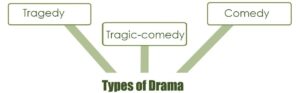 Tragedy-
- A tragedy is a serious story that ends in a sad or disastrous way
- Usually, it ends with the death or total ruin of the main character.
- This person is often someone good or powerful who makes a big mistake or has a specific weakness.
- The point of a tragedy isn’t just to be sad; it’s meant to make the audience feel deep pity for the character.
Comedy-
- A comedy is a lighthearted story that is meant to be funny and ends happily.
- A comedy usually starts with a problem or a big misunderstanding but ends with everything being fixed.
- The main characters often find themselves in silly situations, but they usually get what they want in the end, like winning a contest or getting married.
- The goal of a comedy is to make the audience feel good, laugh, and leave the story feeling cheerful.
Tragic-comedy-
- A tragic-comedy is a story that blends sad and funny moments together.
- It usually has a serious or dark plot, like a tragedy, but it includes jokes, silly characters, or lighthearted scenes to balance the mood.
- Instead of ending in a total disaster, these stories often have a happy or hopeful ending.
- The goal is to show that life can be both painful and funny at the same time.
Types of Tragedy
- Classical Tragedy
- Shakespearean (Elizabethan) Tragedy
- Revenge Tragedy
- Domestic Tragedy
- Modern Tragedy
- Heroic Tragedy
- Tragicomedy
Types of Comedy
- Romantic Comedy
- Sentimental Comedy
- Classical Comedy
- Comedy of Humour
- Comedy of Manners
Elements of Drama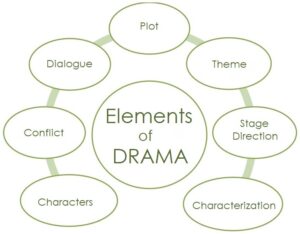
Plot-
- The series of events occurring in a play
- It means plan, scheme or pattern
- It has a beginning, a middle and an end
Characters-
- The imaginary persons shown in drama
- The protagonist is the main character in a play
- Other characters are major, minor, static and dynamic, flat and round
Characterization-
- It means to reveal the peculiarities of the characters
- To gain insight into their personalities, establish connections with them
Dialogue-
- It involves at least two speakers
- Monologue: to speak to oneself
- Soliloquy: character’s thought process expressed aloud
- It reveals the nature of character and gives us information about his relations
Stage Direction-
- Performance of the actors during the course of the development of the story, along with the use of set lighting, music and costumes
- Stage directions are guidelines and suggestions given by the dramatists
Conflict
- It is the essence of drama
- It enlightens life, grants dignity and worth to human life
Theme-
- The main idea or point of a play, stated as a generalization
- It is the central idea, moral or message that the play explores.
- The soul of the play.
What is a One-Act Play?
A One-Act Play is not exactly a shortened play. It is a complete story that has to be performed on the stage in stipulated time. It has its own features and characteristics. The action is confined to a single place and the number of characters is limited. Simplicity of design and quick effect are its features. One-Act Play also includes Plot, Theme, Setting, Language and Characters.
Features of One-Act Play:
- It has one or more scenes.
- It is concise in manner.
- It has a single dominant theme that produces a singular effect.
- It treats problems of everyday life.
- It has a beginning, a middle and an end.
- It has stages like Exposition, Conflict, Climax and Denouement.
- It gives an introduction of stage direction.
- It creates mood or atmosphere.
- It has unity of time, place and action.
- It has simplicity of plot, concentration of action and unity of Impression.
- It has limited characters.
- It presents a question, answers of which are eagerly awaited by the audience.